
Reflect. Create. Share Your Story.
Our past is part of our story, but it doesn’t have to define how our story unfolds or ends. Incarcerated and formerly incarcerated youth in California were asked to reflect on how their lived experience has shaped them into the person they are today and their hope for the future. Youth were asked to create art (in any form) that helps themselves and others who may not know them understand their story, their growth, their strengths, and the hope they carry into the future.
We are happy to announce the challenge winners below. Entries will be shared here on October 8th.
1st Place
Wasted Times
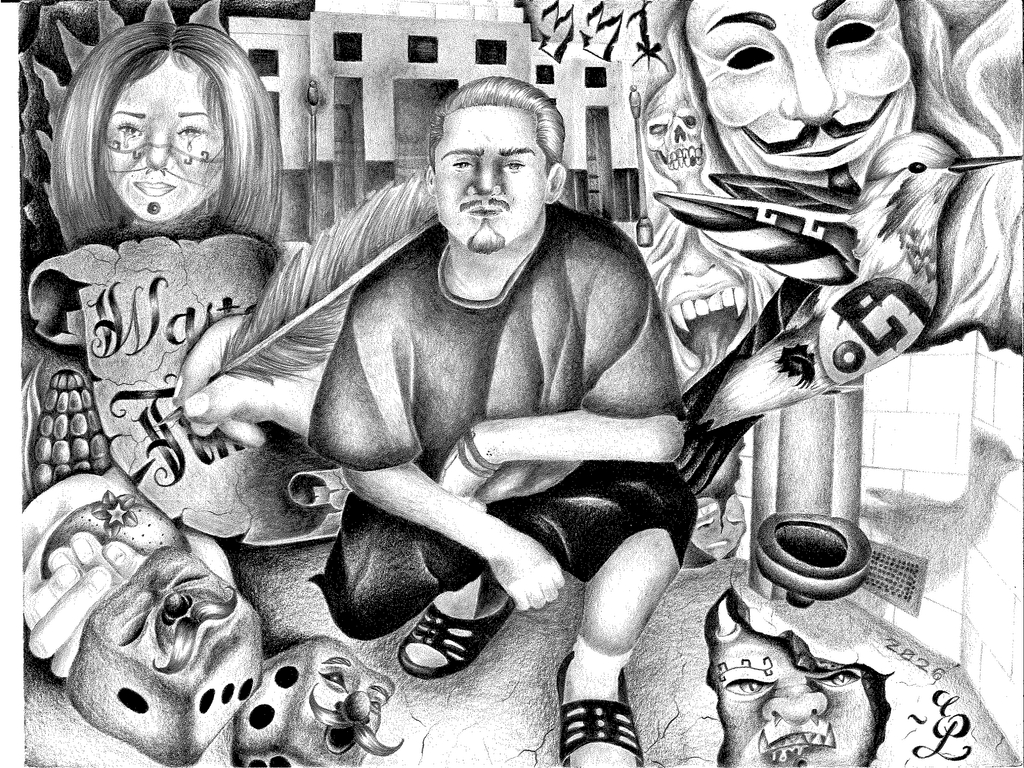
Youth artist statement: “In my 9×12 collage “Wasted Times”, I use graphite on paper to depict and summarize the harsh realities of incarceration and redemption for young Mexican-American youth like myself. The main element in the drawing portrays an image of myself, the artist, kneeling down in a space surrounded by powerful symbols which create layers of my human essence in a world that labels me a criminal, gangbanger and menace to society.
Wasted Times is a collection of representations which aim to humanize what is on the surface, a brown-eyed Chicano boy with tattoos on his skin and scars that silence the chapters of an untold story, my story. On the left-hand corner there is a woman with indigenous adornments that resembles Our Lady of Guadalupe. The face of the woman happens to be my mother. This symbol highlights motherhood/womanhood adversities, because within every single little Mexican girl and Mexican woman lies a version of a loving and compassionate Lady of Guadalupe.
The rest of the collage is filled with symbols that tell the story of my life and the battles I have faced. Above me is a hummingbird, representing Huitzilopochtli, the Aztec god of war. To me, it symbolizes the warrior spirit needed to survive because life itself is a struggle and a constant battle. Next to it is the V for Vendetta mask, which represents the fight for freedom from systems that can keep people trapped, whether through incarceration, probation, poverty, or other circumstances. In the background stands the front entrance of Orange County Juvenile Hall, the place where I have spent the last seven consecutive years of my life, from age sixteen to twenty-three. The number 331 appears as a reminder of the street where this chapter of my life has taken place.
The scroll reading Wasted Times reflects the feeling of lost time rather than time wasted. Although I have grown and learned during my incarceration, there is still a sense of years that can never be returned. The corn and orange represent my Mexican heritage and honor my mother, whose sacrifices and hard work in the fields helped shape who I am today. The smiling and crying faces on the dice symbolize the highs and lows of incarceration, moments of hope, growth, pain, and sadness that have all become part of my journey.
The jail cell, along with the toilet and sink combination commonly found in correctional facilities, represents my physical existence within confinement. Surrounding smoke, cracks in the ground, and dark figures symbolize the inner demons I have struggled to overcome. These battles connect back to the hummingbird and the idea of war, not against other people, but against myself, my fears, my mistakes, and the circumstances that have challenged me. Hidden between the toilet and my right leg is a broken heart with a bandage on its head. This symbol represents my struggle with depression, unanswered questions, and the emotional pain that often accompanies incarceration.
Ultimately, Wasted Times is not about seeking sympathy or making excuses. It is an honest reflection of identity, resilience, and survival. Through this collage, I challenge viewers to look beyond labels and stereotypes and see the humanity behind them. While my story includes incarceration, loss, and hardship, it is also a story of growth, self-discovery, cultural pride, and the ongoing fight to find purpose and redemption. The piece serves as both a record of where I have been and a reminder that my future is still being written.”
2nd Place
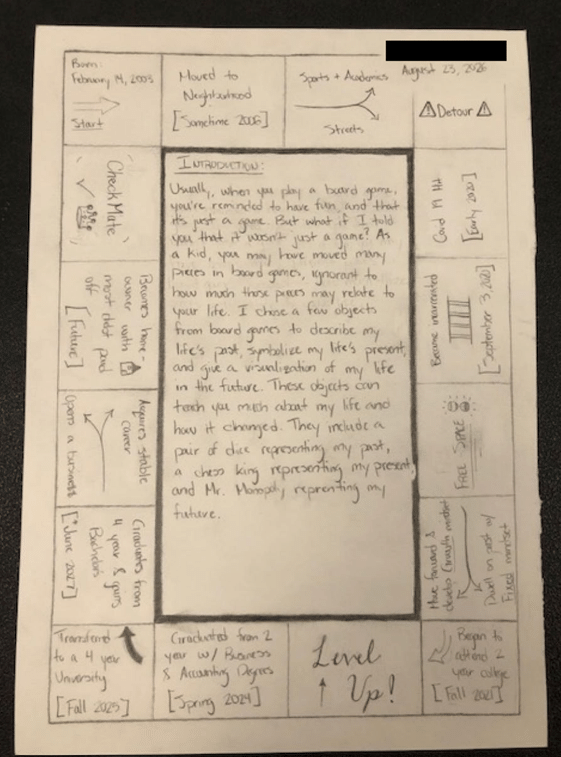
From Start to Finish
Youth artist statement:
“I created an art and narrative story about my life, where I chose three main pieces from board games to represent my life. I chose a pair of dice to reflect my life’s past, a chess king to reflect my life’s present and Mr. Monopoly to give a visualization of my life’s future.”
3rd Place:
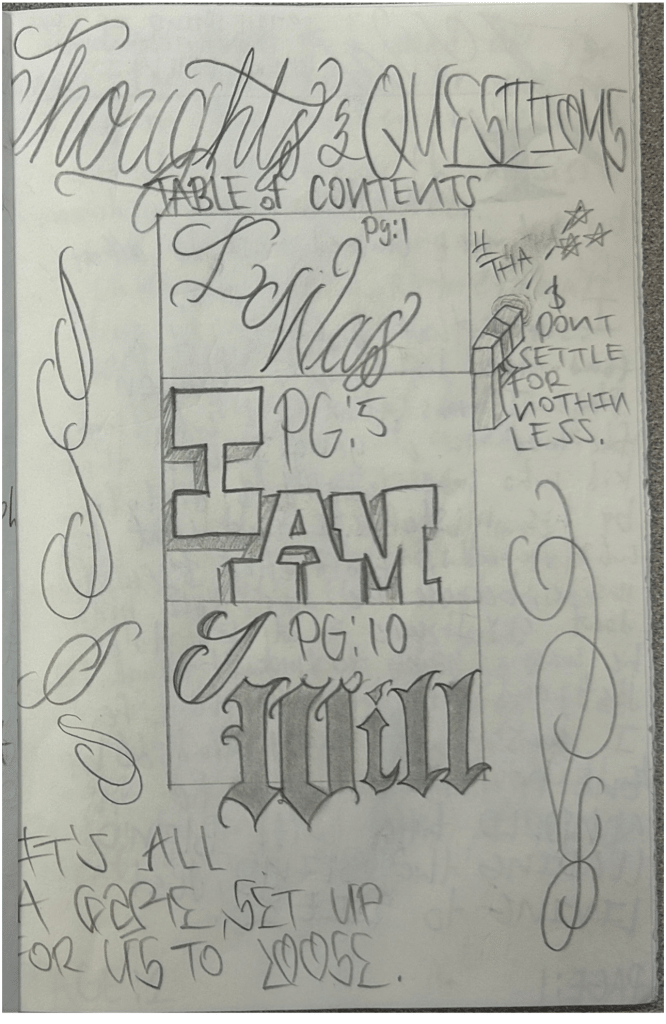
I was, I am, I will…A Short Autobiography
Youth artist statement:
“This entry is a poetic autobiography called “I Was, I Am, I Will,” which I wrote and hand drew myself. The whole book is a quick reflection of my life, including my childhood, my experiences, my thoughts, my feelings, my goals, and my dreams. The cover and interior pages are filled with hand drawn lettering and artwork that represent where I come from and what I have been through. Inside, I broke my story into three parts, who I was, who I am, and who I will be, writing honestly about growing up, the mistakes I made, and the environment that shaped me. I also wrote about staying strong in my faith and believing that God got me through it. In the “I Will” section I wrote about the man I am working to become, someone who helps his community, stays disciplined, and inspires the youth who face the same struggles I did. I hope that when people read this book they can find themselves in the words, and see that no matter what has happened, people can change.”
Honorable Mention:
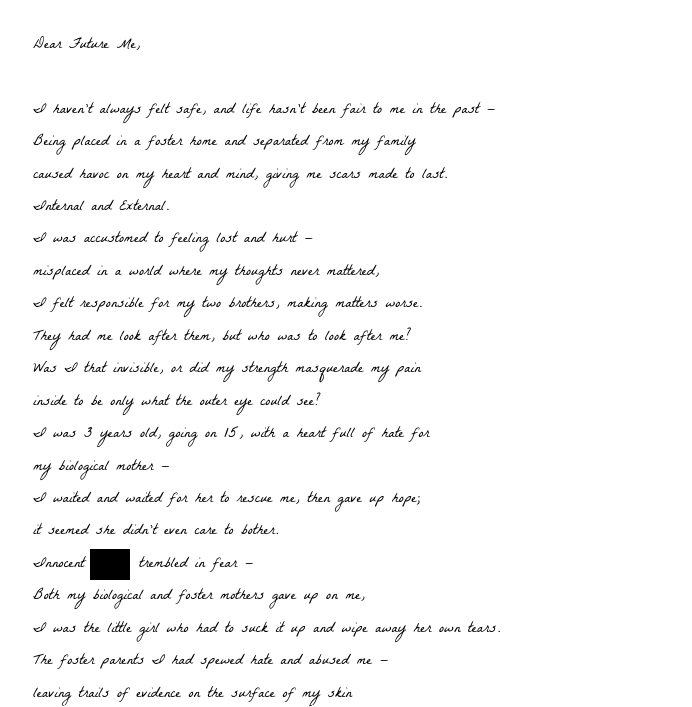
Dear Future Me, (Contra Costa County)
Youth artist statement:
“This youth artist is enrolled in the Day Program with The Gemma Project. She is a bright light whom brings wisdom, joy and authenticity to our group every week. She expresses a strong desire to grow and evolve while also honoring and forgiving her past self.”
Honorable Mention:
From the Bottom Up
Youth artist statement:
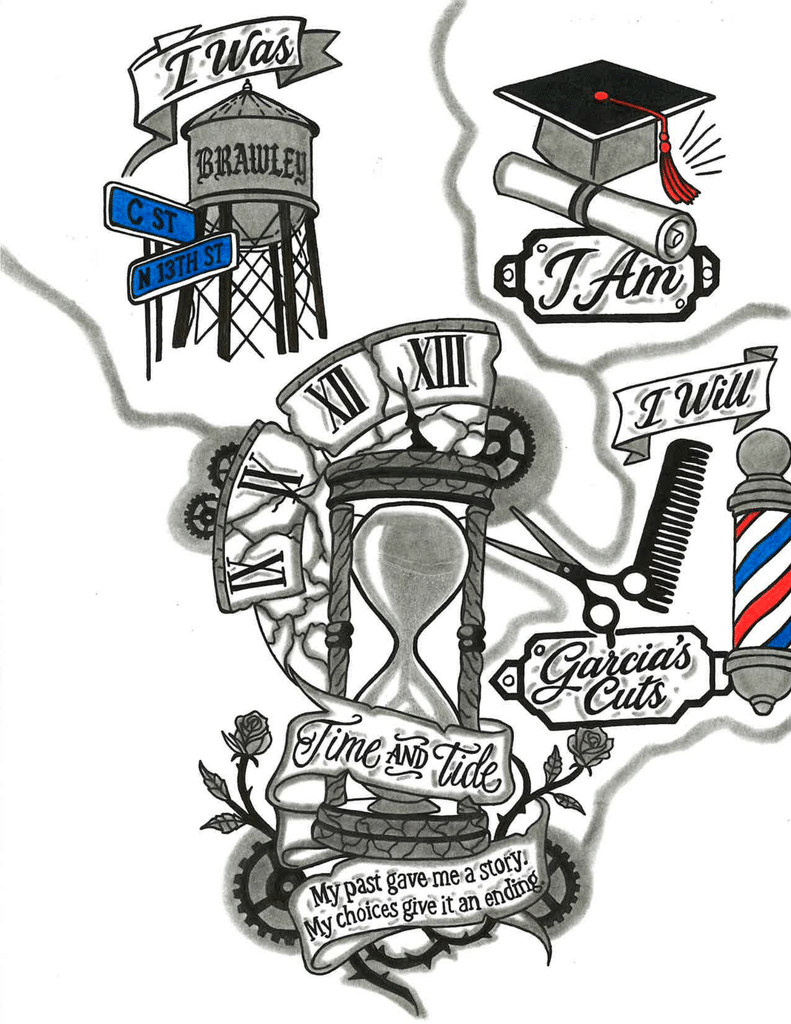
“My past gave me a story. My choices give it an ending. It means just that my story is my past. And that I don’t have to stay stuck in this world. Making mistakes and getting involved with a gang. I am someone learning from my mistakes. I will be a high school graduate, a barber, and a better citizen. I know I still have a lot to learn, but I am choosing a better direction for my life, one step at a time.
I am a kid from Brawley who made some bad choices and got involved with a gang. At the time, I thought being in a gang would make me feel like I belonged and that people would respect me. I was around people and situations that have taken me down the wrong path. I did things that I am not proud of, but those experiences became part of my story. I cannot go back and change what happened but now I decide what happens next.
I am trying to become a better person and a better citizen. The clock and hourglass on my project represent time because time keeps moving, and I cannot waste it. I have learned that the choices I make today can affect my future. I am learning to stay focused, respect other people, and think before I make decisions. I know changing is not always easy, but I want to prove that a person can learn from their mistakes and become better.
The graduation cap represents me completing school. Something I thought I would never do. I have worked hard and learned so many new things. I have opened myself up to a new world I never knew about in my studies. That there is so much more out there in the world that my time could waste away.
I want to become a barber. The barber tools in my project represent that dream. I want to learn how to cut hair, become good at what I do, and one day have my own barber shop called Garcia’s Cuts. I want my shop to be a place where people can come in, get a haircut, talk, and feel welcome. I also want to be a good example for younger kids who might be going through some of the same things I went through.
The roses on my project represent growth and a new beginning. Just like a rose grows even when life is not perfect, I want to grow from my past and become a better person. My past will always be part of me, but it does not have to control my future.”
Contest Details (Contest Ended August 31)
How it Works
- Find an adult advisor, such as teacher, parent, mentor, probation officer or counselor and get set up with Youth Creating Change here: https://youthcreatingchange.org/contest-profile/
- Choose a prompt (see ideas below!)
- Choose your format – a 30 – 60-second video, digital art (poster, Instagram Post or Story), or a spoken-word piece.
- Submit your project by August 31, 2026. On the entry form, select “OYCR” for Contest.
- Win prizes and recognitions – up to $500!
Here are some ideas for what your project could be about:
I was, I am, I will be
Creatively explore how your past and present self are connected to your future self and the person you hope to become.
- “I was” Who you were in the past (your experiences, challenges, people and places that are a part of your history.)
- “I am” Who you are now (the strengths, lessons or talents that come from your lived experience and how they make you who you are today.) Celebrate your growth and help your community and others understand your story and see the hope, strength and possibility inside of you.
- “I will be” Who you hope to be in the future (your hopes and dreams for your future self and the community you want to be a part of.) How can you use what you’ve learned from your past and present to help create that community?
Dear Future Me/Dear Future We
Write a letter to “Dear Future Me/Dear Future We”. Remind yourself of how far you’ve come, what you’ve overcome and experienced, and your hope for the “future you”. Use this as an opportunity to send your future self a hopeful message that reminds you (and others) about your strength and that you are capable of change, growth and healing. Think about the community you want to be a part of and what you need to feel supported.
FAQS
Who Can Participate?
Current or formerly incarcerated youth and young adults in California, ages 12 to 25. Youth who are currently incarcerated will need to work with their probation offers, counselors, or others to facilitate submissions.
What is the submission deadline?
Submit your entry by August 31, 2026.
What are the Prizes?
First place: $500
Second place: $300
Third place: $200
Honorable Mentions (2): $100 each
Prizes will be distributed in the form of gift cards and in accordance with each facilities’ rules and regulations.
Winners will be recognized at the Office of Youth and Community Restoration (OYCR) Youth Justice Summit in October 2026.
Where do I submit my entry?
As a first step, all young people contributing to the contest project and the adult advisor they selected need to set up a profile here.
Then entries can be submitted to the contest here. On the entry form, select “OYCR” for Contest.
How are entries reviewed?
All submissions will be reviewed by the Youth Creating Change team and a panel of judges with expertise in the subject matter including lived experience in the Juvenile Justice system. Entries will be reviewed for creativity and how well they responded to the prompt.
What end slate should I include at the end of my video?
For video entries, be sure to include our custom end slate. A vertical version and a horizontal version is available.
Do I need to sign a release form?
Yes. Everyone who worked on the project and/or appears in your video (including by voice) must have a youth profile with a signed release form. If you’re under 18, your parent/guardian/probation officer must sign, too. This form allows both you and us to share your project. The release form can be found here and will be needed when creating a youth profile.
What languages are accepted?
You can submit in any language — English, Spanish, Sign Language, and more. For all videos, even if it is in English, make sure to add English captions.
Can I use copyrighted music or images?
No. Make sure all music, video clips, and images in your project are copyright-free (or that you have permission).
We recommend using copyright-free / royalty-free / public domain elements in your film. Visit Film Resources to find these elemAny elements in your film or art, including but without limitation to music, audio, stills, video, supers, or other audiovisual materials used must:
● be entirely original, created and performed by the entrant and/or participants; or
● be in the public domain as creative work not protected by trademark or copyright, which can be used freely by anyone; or
● be purchased or released trademarked or released copyrighted elements, such as music, photographs, or logos.
● not have used AI to create any part of the entry (including but not limited to: script, background, editing, etc.). AI models are based on millions of images, including artists’ work, therefore this is not considered to be original work. As storytellers, artists and filmmakers we ask that you act with honesty, integrity, and respect as you create your films for this contest.
To submit proof of release and permission to use copyrighted materials, please include a signed letter or email from the rights holder that indicates the title of the film or art, the name of the contest, the student name or advisor name and indicates that there is no restriction to how the film containing the music/pictures/film is used.
Entries that include copyrighted materials or music without the proper permission and signed release forms will be disqualified.
Pictures and Film Clips: You may use public domain images and film clips in your film or art if you cite your sources in the credits. Please note: Images found in Google searches or elsewhere on the Internet are protected by copyright laws, even without a copyright symbol.
Music: Original music or music in the public domain (royalty-free) may be used in your film or art if the source is cited in the credits. See the Film Resources page for royalty-free music sites. This means you can’t just download your favorite song.
Logos: While it may not be possible to keep all brands out of view, there are easy ways to avoid them from showing. For example, dress your actors in clothing without logos, cover up laptop brands with a sticker or sticky note, or frame your shots so that recognizable stores are not highlighted. Using a brand may limit the use of your film on television or in movie theaters, due to brand copyright laws.
There is a US Copyright Fair Use Policy that allows teachers and students to use copyright-protected material in the classroom. Directing Change entries DO NOT fall under Fair Use guidelines. Since Directing Change-nominated videos and art might be shown publicly, copyright law must be followed.
More resources:
Library of Congress’ Taking the Mystery out of Copyright: an interactive site for teens to learn about the many aspects of copyright.
Copyright and Public Domain: A reference site to help identify public domain songs and public domain music, royalty-free music you can use anywhere and any way you choose, performance, sing-along, film, video, advertising, business, or personal.
How will my entry be used?
Winning projects may be featured on Youth Creating Change and the Office of Youth and Community Restoration (OYCR) websites, social media, awareness campaigns, educational resources, and more.
Who is this challenge funded by?
In partnership with the nonprofit organization Youth Creating Change, the Office of Youth and Community Restoration (OYCR) is supporting this challenge for schools and organizations serving systems-involved youth to encourage young people to express their lived experience through art.
I am looking for mental health resources
Here are a few resources to get you started!
Soluna App:
Offers free mental health support for 13- to 25-year-olds in California, Soluna lets you chat 1 on 1 with professional mental health coaches. Plus: free-writing journals, de-stressing tools, and forums where you can get and give advice (or vent). Free and confidential.
www.solunaapp.com
Mirror Journaling App
Mirror is a digital journaling app created by experts at the Child Mind Institute to support the mental health and emotional well-being of teens and young adults. It offers a safe space for self-reflection through text, audio, and video journaling — with AI-powered insights, mood checks, and guided prompts.
www.mirrorjournal.com
Teen Line:
Call 1-800-852-8336 (from 6 p.m. to 10 p.m. PST)
Text TEEN to 839863 (from 6 p.m. to 9 p.m. PST)
www.teenline.org
@teenlineonline
Teen Line is a teen to teen hotline where teens can call, text or email about anything they are struggling with. Teen Line is staffed by trained teen listeners who understand what it is like to be a teen. No problem is too small, too large, or too shocking for the Teen Line volunteers.
988 Suicide & Crisis Lifeline:
Call or text 988
988 Chat
988Lifeline.org
Provides 24/7, free and confidential support for people in distress, as well as prevention and crisis resources.
Crisis Text Line:
Text HOPE to 741-741
Connect with a crisis counselor 24/7 to receive high quality text-based mental health support and crisis intervention.
The Trevor Lifeline:
866-488-7386
The Trevor Project is the leading national organization providing 24/7 crisis intervention and suicide prevention services to lesbian, gay, bisexual, transgender and questioning (LGBTQ) young people ages 13-24.